

Book Date No. 26
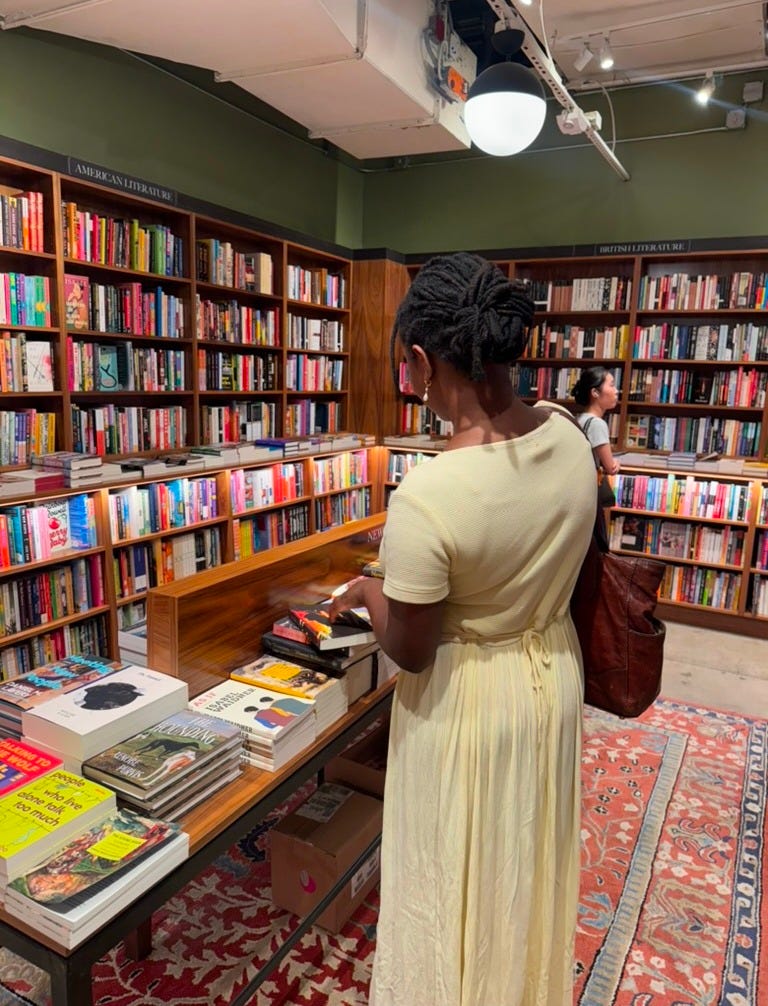
A trip to McNally Jackson SoHo with writer Stephanie Wambugu.

When I first read the blurb for Lonely Crowds sometime last year it shot to the top of my TBR. I followed Stephanie on Instagram shortly thereafter because I was excited by what she was doing. Over the past year or so we’ve developed a digital correspondence, a DM here, a like there. Eventually I asked her if she’d go book shopping together and after some effort to sync schedules we met at the McNally Jackson in SoHo she worked at in grad school, where we talked about the books that shaped her perspective, what constitutes good writing, and the novels she’s reading as she writes her second book.
Read about our date, below.
Can you state your name for the record?
Stephanie Wambugu.
And what do you do?
I’m a writer.
Where are you from?
I’m Kenyan and I grew up in Rhode Island. I’ve lived in New York—upstate and in the city—for the past 10 years.
How did all these places shape you and your perspective?
Being Kenyan, I feel a little bit out of step culturally with my generation. I feel my parents seem much older than they are, although I have kind of young parents. But that’s been nice for me. It made me feel like I had an analog childhood and a sort of religious childhood. In Rhode Island, I learned how to be bored. How to live in the suburbs and make my own fun and find people who are like-minded in a place that was really homogenous and can be kind of boring. It’s also a naturally beautiful place. I benefited from that and I got a good education. I think of it fondly, but I don’t go back very often. And New York, I mean, it’s a mecca for artists and writers. I can’t imagine myself living anywhere else. It’s been wonderful.
What was your young reading life like?
I was very bookish, type A. I read everything that was assigned to me and more. Reading anything that was age appropriate and not. I loved the librarians. I loved going to the library. My parents tried to cultivate a reading life for me. I’ve always seen it as parallel to other kinds of entertainment, like movies and TV. I was reading everything, age appropriate and not. I remember reading The Bluest Eye as a preteen and trying to read things that were above my level of comprehension or more mature subjects than what I was maybe ready for. I had an insight into adult life through reading more than movies or any experiences.
Were there any books that stood out to you from your childhood or your young reading life that really have made an impact on you?
Sandra Cisneros. Toni Morrison. Toni Morrison is the first writer I read who I thought, okay, these are really, really great books. It exposed me to something that I otherwise wouldn’t have been exposed to. And then of course all the commercial popular books like the Harry Potters, and everything else that I don’t actually remember the details from now.
Are there any books that have really shaped your perspective or shaped that you would say kind of like if someone wanted to know you, what books would they need to read?
Song of Solomon by Toni Morrison. Horse Crazy by Gary Indiana. So Much Blue by Percival Everett. Giovanni’s Room by James Baldwin. With So Much Blue, I was already beginning to write my book and my book was about Black artists. Basically it’s the book I wanted to write. It was incredibly influential in terms of writing about Black identity and Black middle class identity. I didn’t anticipate that there was a novel that already talks about that experience so fully. It’s so skillfully done. Everett wrote about art in a way that was so interesting and wrote about this person’s vocation as a container for all the things they were dealing with psychologically. It’s similar to what I wanted to do with painting in my book, where a painting becomes a container for the character Ruth to deal with all of her kinds of evasions and personal problems and so on. Then, many, many books by Annie Erneaux. Most recently, The Years. I read it a couple of weeks ago. I feel like she’s writing a history of France from the 1940s and 50s to the 2010s. She’s trying to write a personal history alongside the nation’s history. It made me understand what I’m trying to do with my second book. That felt really formative. It made me want to write about what’s going on politically. My second book has a bit to do with the pro-Palestine encampments and with someone getting kicked out of school for participating in them. I want it to be both about that historical moment, but also about a woman’s personal life while dealing with a world historical event. While history’s happening in the background, these very personal things can happen that feel actually on par with these more important events. To go back to Song of Solomon, it does that really effectively with the The Civil Rights Movement and then what follows it, the Black Power movement, which happens alongside Milk Man’s life. But it’s also about his family dilemmas. It’s a domestic drama. What I really hope to do is put a domestic drama or a personal drama alongside the drama of history.
I love when books do that. Toni Morrison always does that to varying degrees. I think it helps to orient us, in a way.
True. Same thing with Sula. The sexual revolution is happening in the background of that novel. I taught a McNally Jackson class about Song of Solomon and Sula. It was called The Social and the Domestic and it was sort of about the social movements that were happening in the background of the domestic home lives of the characters. So yeah, those are my concerns as a writer.
What’s the last book you finished?
