

Book Date No. 25
A trip to Gladys Books and Wine with writer and professor Briona Simone Jones.

As promised, this month’s Book Date! I realize this is coming quickly after my very late Final File so thank you for bearing with me as I try to get on some sort of schedule amidst finishing the manuscript and being very outside. Anyway!
For this edition I went out with Briona Simone Jones, professor and author of Mouths of Rain, an anthology of Black lesbian thought. I’d bought the anthology when it came out but was reminded of her work a few months ago when I heard her speak at the Schomburg alongside Dr. Beverly Guy-Sheftall. I was immediately impressed and DMed her the same day asking if she’d let me interview her. Thankfully, she agreed.
We met at Gladys back in May, where we talked about Miss Frizzle being gay, the literary criticism she returns to, and the person in her life with the best reading taste. Read about that, below.
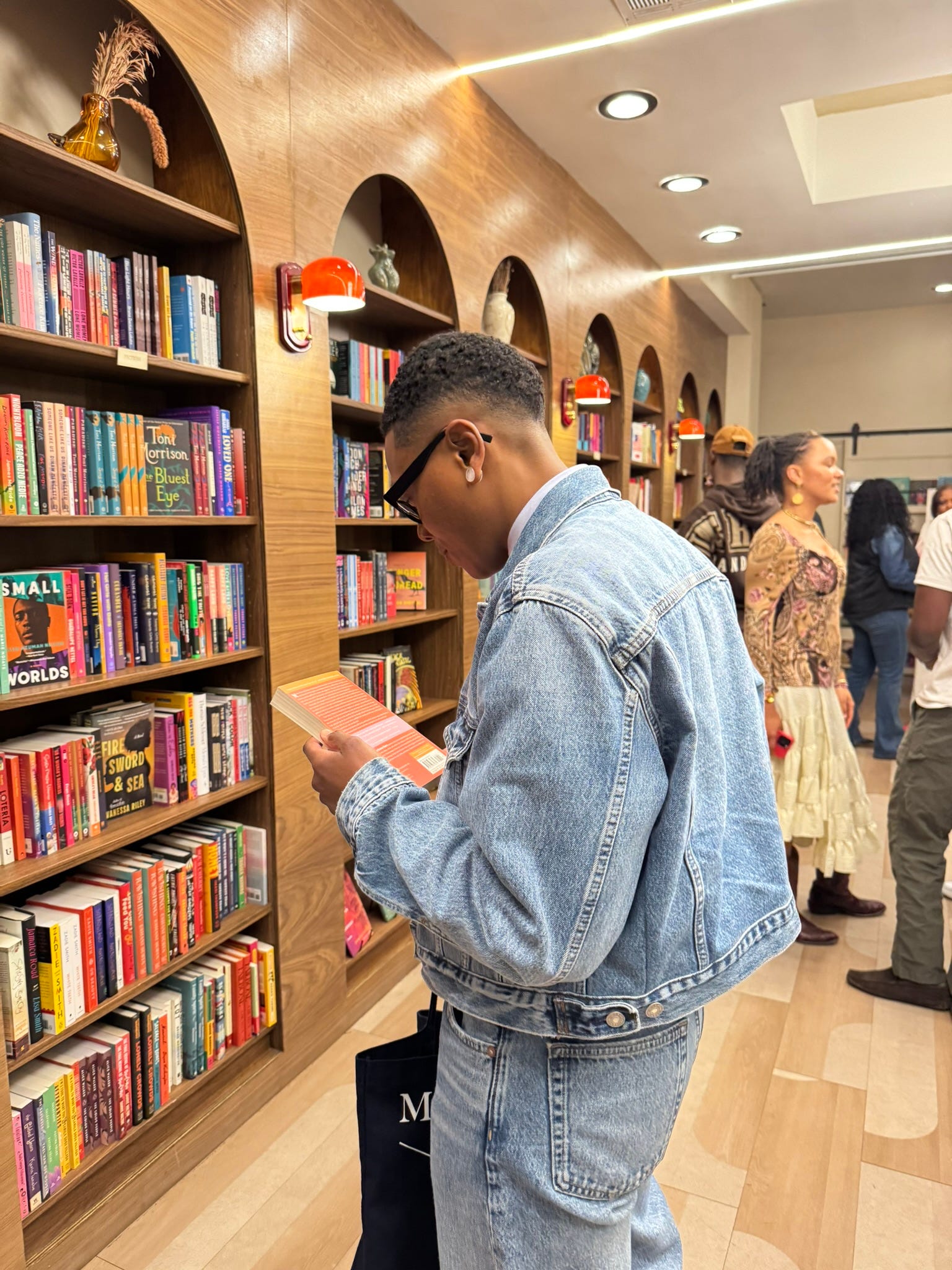
Can you state your name for the record?
And what do you do?
I am a writer and a professor of queer studies at Spelman College.
Where are you from?
Rochester, New York.
How did growing up in Rochester shape you?
Rochester became a sort of central reason that I decided to leave. I wanted to have an intimate relationship to home, but recognized that Rochester couldn’t withstand the way that I would expand as a person, as a queer subject. It’s an impoverished city that’s highly segregated. Those sorts of barriers become grounds of an impossible life. But I love it and I love the abolitionist history that we have. Frederick Douglass found his way there after enslavement. So did Harriet Jacobs. I see it as a place to develop a consciousness, but I really wanted to leave. I felt like I had to in order to become who I wanted to be as a person seeking a Black, free queer self.
What role did reading have in your young life? What was that like?
I mentioned this in Mouths of Rain, that books became a portal for me to conceive of myself anew, but to also build a world that I did not feel like I had access to. With the absence of cable and internet, books were really foundational in terms of me discovering who I was as a queer person. They became a way for me to connect with my family. My grandparents were sharecroppers from Mississippi and they had not learned how to read or write. I noticed very early on that there were barriers in our communication because of this epistemic injury. Books became something I would bring home to family to relate to each other in what I thought was a deeper way. It became a communicative resource for me. Beyond that, I was afraid to be out and to seek queer community in Rochester so books became the space for me to map a queer life before I had the courage to walk in it.
Were there any books that were formative for you?
I was a Scholastic Book Fair kid. It was central to my life as a little person turned scholar. I loved the Arthur series. There was something about The Magic School Bus and Ms. Frizzle. I was like, she’s gay. I don’t know how to prove it. There was something queer about her being a driver and a leader. That book taught me, in a way, about magical realism. When you’re sort of low income, you got to disassociate a little bit. You have to kind of think about the magical nature of life in order to make it through. Magic School Bus was an alternative universe that I did not have access to but allowed me to dream. Beyond that, my mother introduced me to Audre Lorde, which is ironic. I don’t think she thought putting me on would make me gay, but it did. I read the poem A Litany for Survival. Although it’s a triumphant poem, it was a litmus around what it means to choose yourself in spite of whatever fear might be on the other side of that choice. Being raised Baptist, you’re like, if I come out, I’m literally going to die. So one does not think about survival. A Litany for Survival was my Dreams and Nightmares. It was my March Madness. That poem prepared me for the game of life.
What’s your reading life like now?
Right now I have less time to read for leisure and more time to read based off of work that might be in my dossier for tenure. I’m also reading a lot more theoretical work and work situated in Black studies because I’ve been commissioned to write more art criticism. I was recently rereading Tina Campt’s A Black Gaze and her book Listening to Images, which is about photography. I’m writing about Zanele Muholi’s work.
Is there an art critic you really admire? Books of criticism you would recommend?
