

Book Date No. 21
A trip to Unnameable Books with Doreen St. Felix.

Normally these posts are paywalled, but this installment is free to read, thanks to Honey Pot.
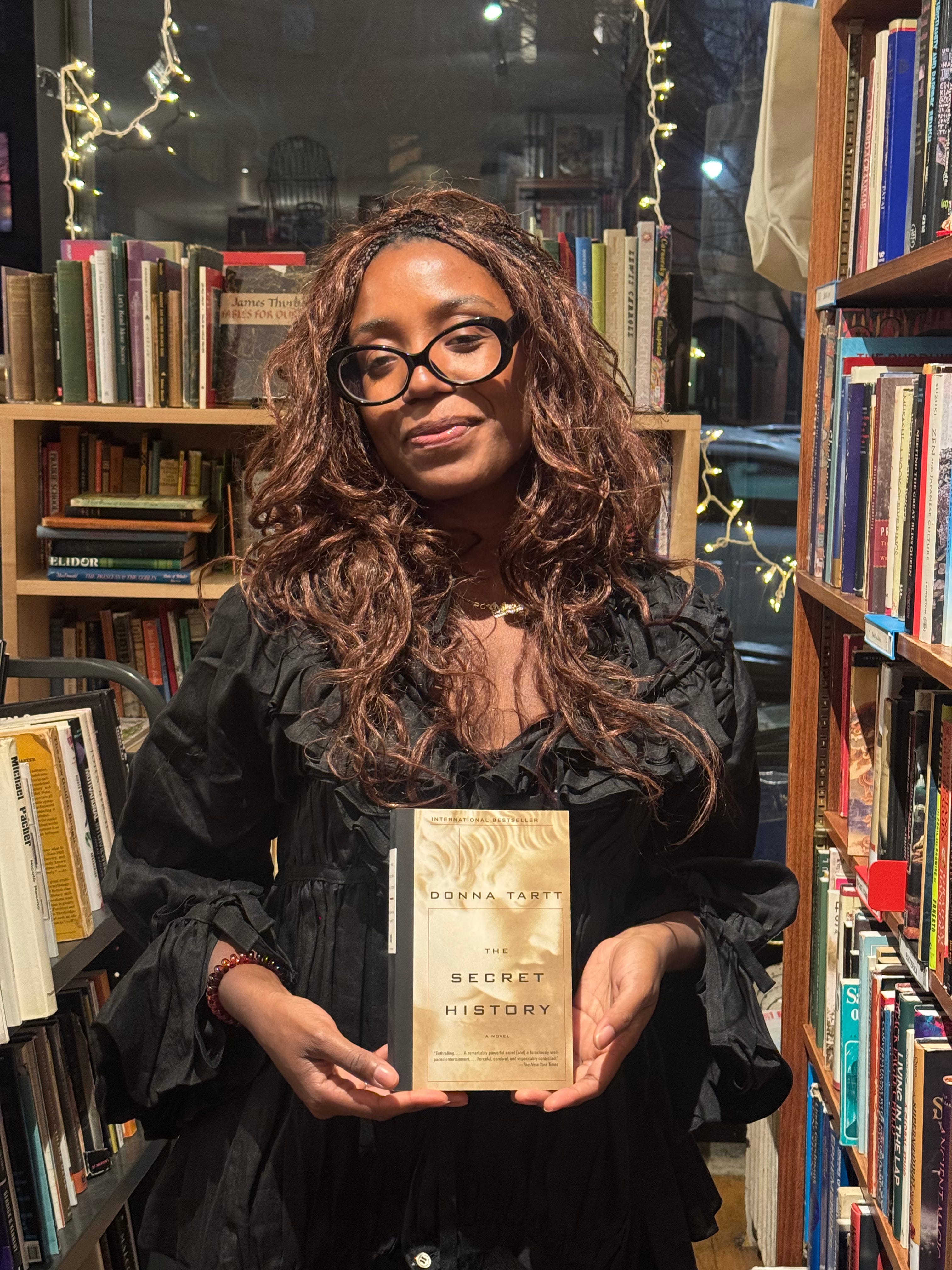
For this edition of Book Date, I went out with writer Doreen St. Felix. I’m a longtime admirer of her writing and after hearing her in conversation with Sasha Bonét back in September at the launch event for The Waterbearers I knew I wanted to hear more about her reading life. We met at Unnameable Books, which I haven’t been to since my first book date, where we talked about the book she read too young, structure as the point, and her reading routine.
Can you state your name for the record?
What do you do?
I’m a writer.
Where are you from?
Brooklyn, New York. Canarsie to be exact.
How did growing up there shape you?
The horizon was always Caton Avenue. I thought that was the whole world. I knew nothing of Manhattan. I grew up in Canarsie at this really interesting demographic shift. White flight was almost complete when we moved in in the mid ‘90s. My neighborhood was a bunch of Caribbean people, a lot of Filipino people and a lot of church people. Everyone was quite churched on my block. In some ways it was that idyllic Crooklyn vision of childhood with a dark underbelly. But it’s my reference for everything—an extremely religious immigrant swamp community at the edge of Brooklyn. It’s weird when you grow up in a neighborhood like that and then you eventually cross over. You learn about Manhattan, you cross the Brooklyn Bridge and you realize that the New York that you feel is yours is not actually fully yours. There’s a little grief in that. That happened for me when I went to high school because I went to high school in Manhattan.
What was your young reading life like?
I was not a very verbal child. I was very shy. I did not like to be talked to, but I liked books. I would hide in the bathroom and read book after book after book. It was obsessive, addictive. It was cover, I think, for some interior discomfort with being a person in the world. I’m the youngest in my nuclear family by a lot of years. There’s a big generational gap between my parents and my sister. I was always trying to understand who they were by reading what they were reading. My mom was getting her associate’s degree at Kings County when I was a kid. She took an elective and it was an English literature elective. She’s from Haiti, so she didn’t really know about English classics. Everything that she brought home, I would try and read. She became really obsessed with—I mean, this isn’t English literature—but, Ibsen. I remember she was reading A Doll’s House, so I read A Doll’s House with her, not really understanding what it was about. Reading was a way of making myself visible when every other avenue was not available to me because I was so shy. It was a way of trying to understand the older women in my life, that being my mother and my sister.
What kind of books were you reading as a child? What did you really enjoy?
I remember reading Roll of Thunder Hear My Cry, because again, it was just on the shelf. After that, my most visceral reading memory is Assata. I had a cousin who was being radicalized at that time, my cousin Rudy, and he gave it to me for Christmas.. It’s funny that my first real memory would be of nonfiction, something in the memoir mode. It was the first time I realized that you could do that to life, that you could subdue it and turn it into narrative, to say nothing of how it made me think of myself—as someone who was about to be a Black woman. That book was really important to me. I, on the other hand, was a total romantic. As I got more preteen, I was such a Jane Eyre girl. Mr. Rochester, sexual awakening. There were certain books I read that I don’t know if I necessarily liked, but I knew were integral in me understanding that there was an adult world. I think of Push as being one of those. Really random, but The Five People You Meet in Heaven. As I got a little older, my friends and I would hang out at Barnes & Noble all the time. It would have these NPR-core displays of what you’re supposed to read, and before I developed my own taste, I would read those books. That is a real core memory of being like, oh, this is what contemporary literature is. The Bluest Eye was really critical for me. I have a memory of being on my mother’s bed and reading it in one sitting. I remember feeling pained because I couldn’t talk to her about it because she had never read any Toni Morrison. Then I did the kind of complicated gesture that some Black women do where people try to claim her as a maternal presence, even though that’s not what she’s doing. Toni Morrison is not your mom. Also Edwidge Danticat’s Krik? Krak!. That was quite personal because my parents taught us about Haitian culture, but we didn’t read Haitian literature. That explained to me our way of talking to each other, the way that we had a call and response rhythm embedded in how we communicated. That book was very essential and demystifying.
Is there a book you read too young?
Assata. I’m the youngest in my cohort of cousins by far. The 10 to 12 year age difference that I had with the rest of the people in my family made me yearn to be older in a visceral way. When they were getting woke and deprogrammed, a lot of what they were experiencing would trickle down to me. Obviously precocity is something that was very much fetishized and valued in the ‘90s, but I do think there’s something to be said about protecting innocence. I wish that I had read that when I was maybe 12 or 13 years old.
A book you still don’t fully understand?
For years, I have been trying to get through Ulysses. I recently learned there’s a way of reading it that’s not chronological that I should maybe try. The right way to read it is to go through certain later chapters first. That is a book that gets into you, I am always beset by nightmares as I read. It’s like my body physically rejects it. That’s where the lack of understanding comes from. There’s something about the bodiliness of Ulysses that I respond to, but it makes it impossible for me to actually get through this book. I think I’m on year five of trying to finish Ulysses.
What’s your taste like these days?
I don’t read a lot of contemporary literature. I have an aversion to how sentences have shortened. The margins are wider. I like to read literature that’s not about where I am. It’s not about the literary space in New York. I don’t really have that much of an interest in it. I find myself going for books that are maybe like 50 to 60 years older. I’m very interested in the ‘70s. I read a lot of Bessie Head last summer, a really incredible South African novelist. She wrote this book called A Question of Power. It was written after her mental break and she embeds within the narrative what it must feel like to lose sense of one’s ability to make sense. That book is unbelievable. Ready to Burst by Frankétienne is a novel that is really emblematic of the spiralist movement. I think a lot of people would feel some kind of relief if they could learn about this way of telling novels in which time is not just marching forward. It spirals like a conch shell. It’s funny, a little bit of a nasty book. The Vegetarian. A really important book to me last year. If we’re getting Kafka-esque, I’m there. Hangman by Maya Binyam does that too. I love a fable. I love parables. If Catholicism is literary, it’s literary because of the Bible, and it all begins with the word, right? So when I’m reading books that are built on that structure, my lizard brain gets activated and I get really turned on. Lately I’ve been drawn to books where the structure is the point. Two that come to mind for me are Minor Detail by Adania Shibli and Asymmetry by Lisa Halliday. Those are two contemporary novels where the question of structure is not so attached to memory. Memory is what we think about when we think about a novel deciding to mess with structure, but with these, it’s a lot more embedded in the anti-imperialism in the novel.
What does your reading life look like now?
I wish my reading life was a little fuller than it is. It’s very hard to read these days. I’m also into doing the completist route of writers I like. I’m going through all of Elizabeth Hardwick’s output, in part because I love reading criticism. Flyboy in the Buttermilk, Greg Tate, huge text for me. White Girls by Hilton Als is huge for me too. But Elizabeth Hardwick, her book of literary analysis, Seduction and Betrayal, has been important to me for years. I’d never read any of her novels until recently. I read Sleepless Nights. I love seeing the writer as critic and then the writer as novelist. Maybe because I’m at a transitional point in my own writing life, it’s very attractive to me right now. Right now, by my bed I have Drive Your Plow Over the Bones of the Dead by Olga Tokarczuk. I don’t know if I’m enjoying it but I’m gonna push through. I like pushing through.
So you’re not a DNF’er.
No. Very rarely do I do that.
What does your reading life look like? How are you fitting it in?
I do it really early in the morning. I don’t believe in distracted reading. I need to have a clean mind. It’s about getting in a hunched, uncomfortable position, being a little bit cold and sitting for hours. When you have the disconnect from a book because you’ve put it down for too long, I’m just so frightened of entering that space with something that I’ve decided to read. Books are sacred, so I want to know I have the right mind and the right time to read. I did get a Kindle recently, which I never thought I would do. It’s kind of fab.
Say more about the fab Kindle.
Books are mass. They take up a lot of space. I don’t have space for every book in my house. I’ve been reading these history books by this Catholic writer-historian Gary Wills. I’m not going to buy Gary Wills’ books, but I want to read them. I can do that on my Kindle.
Who in your life has the best book taste?
My friend Durga Chew-Bose. She has great book taste. Sarah Nicole Prickett also has incredible book taste. My friend Nick Glastonbury, who is an anthropologist, has good book taste. The stuff he puts me onto, really incredible. I also have friends who keep up to date with romance novels and whatever’s happening in the YA space. I really appreciate it because I’m so not clued into it. I feel like I’m getting a sense of reading appetite from them.
What’s the last great book someone recommended?
The Sea, The Sea. It’s about a dandy figure, who does not seem to be aware of his effect on others. He’s totally delusional. He won the Man Booker Prize in 1975, and it’s about his retired life. It’s kind of long.
How are you storing all the books you do have?
I’m getting this bookshelf made. Khalil’s making it. He’s a great carpenter. Half of the wall, we did four rows of books and now we realize we need to do the other side. I also love to have stacks by the bed.
Hardcover or paperback?
Paperback. It’s lighter.
What are you thinking deeply about?
Illness. On Being Ill by Virginia Woolf is my formative essay both in form and in subject. It’s Virginia speculating on why illness is not the great muse of contemporary novels. Romance is an engine. War is an engine, but not illness, in part because confronting that our bodies have to deteriorate is the great crisis of our lives. I grew up in an environment of sickness. A lot of people that I love have always been ill. For me, it’s a greater push to act than the optimization health culture that we’re in. I’m so much more comfortable around the weather that’s around when people are sick and they’re trying to get better and to take care of their bodies. That to me is where I feel the most alive, more so than this super obsessive running all day, optimizing your diet culture that is becoming dominant right now. My mother is a nurse and she worked at Coney Island Hospital when I was a kid. There was no one to watch me after school, so she would sneak me into the hospital. I would just chill with the nurses at the station on the coronary recovery floor. I would be in the waiting room, I would talk to patients. It was my playground. I’m uncovering the ways that that’s been extremely formative for me. I’m trying to sublimate it into a short story.
That’s extremely exciting to me. Lastly, what’s your favorite extracurricular activity?
This is going to sound real auntie-ish but I love cooking. I love drawing out the necessity of feeding myself and people I love to a whole day affair. I love the drama of one vegetable being on sale at this supermarket, and another being on sale at the other supermarket. I’m completely inefficient—I’m going to spend three hours getting these ingredients and I’m going to do a mise en place on the countertop. Right now I’m also maybe trying to learn to play basketball because Love and Basketball.
Thank you both for this lovely read, there are some great recommendations here.
On the topic of Ulysses, I am currently enjoying an audiobook version which is the 1982 RTÉ full cast production of the book for James Joyce’s 100 year birthday. It is done like a radio play with Irish voice actors and some sound design which brings the scenes to life. I have found it very helpful for separating some of the threads of thought and conversation when it gets more stream of consciousness-esque. You should be able to find it as a podcast on most platforms.
https://en.wikipedia.org/wiki/Ulysses_(broadcast)
I loved reading this and it has me reflecting on so much especially the writer as critic moving into a space of the writer as novelist.