

Book Date No. 19
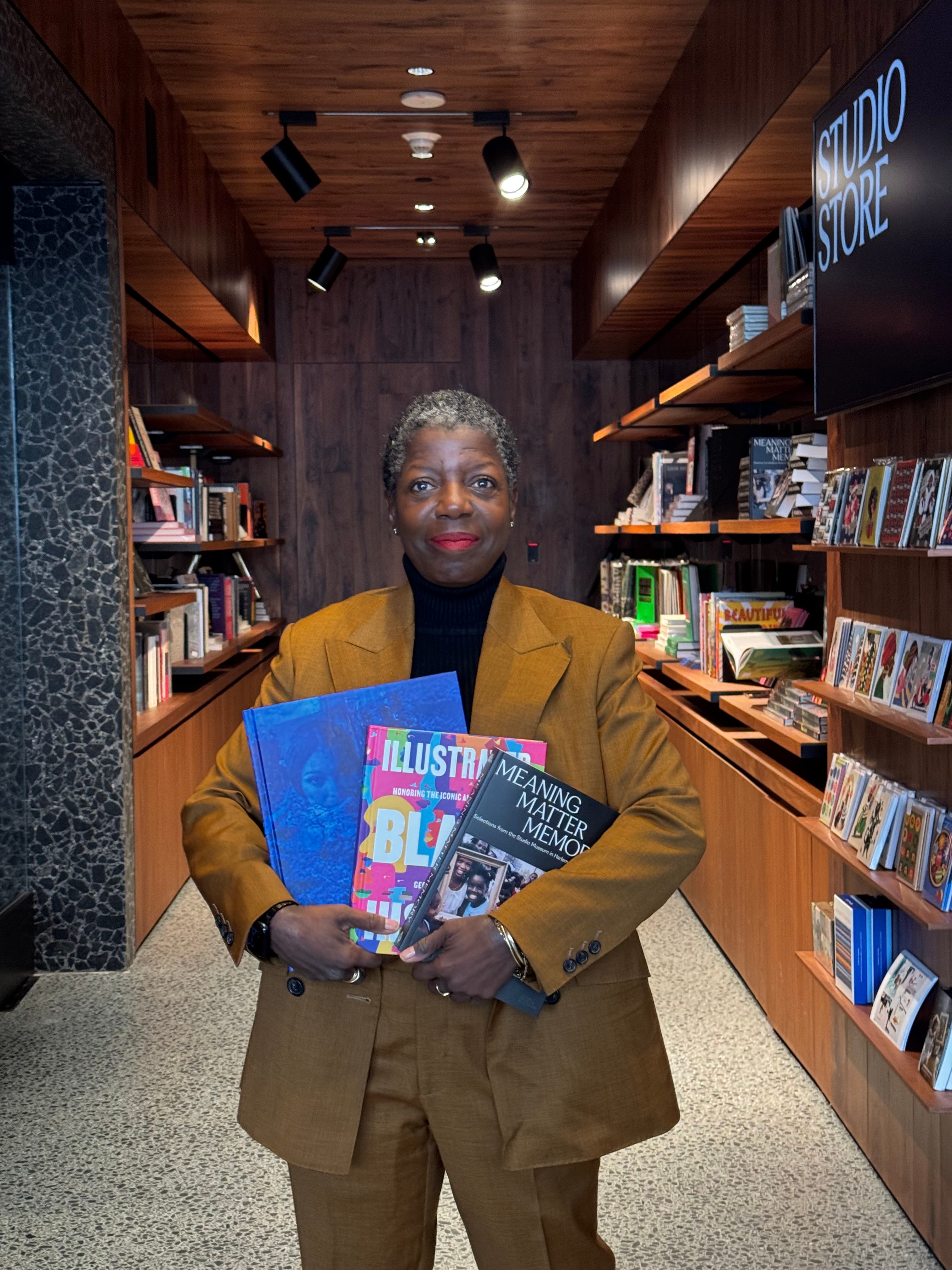
A trip to The Studio Museum Bookstore with director and curator Thelma Golden.

In December I had a book date with the inimitable Thelma Golden. Not much to say about it except that it was an honor and a privilege to hear the way she thinks about the world and crafting an art-centered life. We met at the Studio Museum store on an icy day where we talked about the books that shaped her young reading life and the writer who continually shapes her reading taste. Read about our date, below.
Can you state your name for the record?
Thelma Golden.
And what do you do?
I’m the Ford Foundation director and chief curator of The Studio Museum in Harlem.
Where are you from?
St. Albans, Queens.
What was your reading life like as a kid?
I grew up in a home, that sort of privileged reading as am acceptable and appropriate activity at any time and any moment. I also grew up in a home where my mother made a physical room in our house—what might’ve been the den for other people—into a library that my father populated across lots of genres. I also felt lucky because as a child who liked to read, my father did not make distinctions between children’s books and adult books. I often engaged with books that were far beyond my level of comprehension because they were there. Books were an important part of our daily lives. I had teachers who encouraged my reading and grew up in the Queens Public Library system. I think about the librarians at the main Jamaica branch who completely encouraged the range of my interests that were made even more possible because of the ways in which they allowed me to explore my curiosities through books. I grew up in St. Albans, so I went to the St. Albans branch. As a young person, I could walk from my house, but the great signal of my maturity was when I was allowed to take the bus by myself to Jamaica Avenue and go to the main branch.
What were the first books you remember?
The books I remember, and I think they were not the first—obviously I was raised on a whole diet of children’s books—but the first book I can remember my mother speaking about as important to her was Paule Marshall’s, Brown Girl, Brownstones. My mother grew up as a child of Caribbean immigrants in the thirties and forties in Brooklyn. I realized when she gave me that book, what she was telling me is, this is the world I come from. For my father it was Go Tell It On The Mountain. I remember him broadly speaking to me about the work of Langston Hughes and James Baldwin. Baldwin is from Harlem and Langston Hughes made his career here. My father was born in Harlem in 1926. It did not occur to me again until I was older that my father lived in the world at the same as those figures.
What’s the first book that changed you?
Brown Girl, Brownstones. The story of this young girl and an understanding of history and family and identity. It was special because my mother offered it to me. I also think of Roll of Thunder, Hear My Cry. I can think of so many books I read as a very young person that allowed me to understand the power of narrative. When I was in 10th grade, the head of school at New Lincoln was a fantastic, legendary educator named Verna Oliver. She proposed as an extra credit project that we read Invisible Man together chapter by chapter. I went to her office on what would’ve been my PE break for what felt like the entire school year reading and talking about Invisible Man with her. She gave me a paperback copy, which I still have. In a way that felt like the opening for me into my commitment and stewardship of black art and culture.
Any notable books this year?
A highlight of my fall as The Wilderness by Angela Flournoy. I loved it because it’s such a profoundly insightful, expert exploration of black sisterhood, both within and outside of the bonds of biology. That is something that has powered my life. I do not have biological sisters, but I have sisters who have been a deep part of the way in which I understand myself. It also allowed me to process a lot of what has happened in the world because her characters moved through this contemporary condition, both here in Harlem and LA. Over the last couple of years I had given myself a curriculum where I was reading lots of novels set in Harlem. So, doing a lot of rereading in this moment of the museum and wanting to both hold that history of Harlem, Harlem as a character in our literature, but also to be able to better narrate for myself what this moment in Harlem would mean. So the fact that I finished that curriculum in the spring and then read Angela’s novel this fall, it sort of was the last novel I read, which is set in Harlem and in the contemporary moment.
Any books you’re hoping to get to?
Lonely Crowds by Stephanie Wambugu. The Loneliness of Sonia and Sunny by Kiran Desai. Nia Imara, Painting the Cosmos. There are many new exhibitions with fantastic catalogues, and one amazing one: Ideas of Africa: Portraiture and Political Imagination, edited by Oluremi C. Onabanjo. I’m also a rereader, I’m constantly going back to books. Then there’s certain books I like to read at certain cadences. I read Sula every three years so I feel like I’m at that time. I’m always moving between old and new. Fiction is the thing I read the most but I also read a lot of nonfiction. I love essays. I’ve been really rereading [Joan] Didion over this past year or so. I am always thinking about the ways that my reading life can be in conversation with my looking life, because my looking life is really what consumes me. I spend most of my time looking at art. Sometimes I want [the book] to be different. At other times, it’s a way to go deeper into what might be.
Why did you pick the Studio Museum bookstore?
I love catalogs and art books and my relationship to my interest in art really began in museums as a young person going on field trips and growing up in the city, but also in the library, looking at big monographic books of artists and flipping through them at the Queensborough Public Library. Those books were not for circulation. They were books that I looked at at the library. They appeared to me then to be huge, both big and thick. They continue to be, that’s just the nature of them. As a curator, I think about the catalogs for my exhibition as worlds unto themselves. They’re related to the exhibition, but at the same time, they’re crafted and created to allow someone an experience even if they did not see the exhibition. When I look on TikTok, lots of people use art books as decor. I’m not a hundred percent mad about that, but I often want to say to people that it can be like having an exhibition in your home. So when I see them closed in people’s homes, I say, no, open it. Give yourself the chance to take a look. Maybe every day, turn a page, look at a work. And also, if you are intrigued, take a look at the writing that’s inside.
Who in your life has the best reading taste?
This is a hard one. One of the great privileges of my life is that I have come to know many of the writers whose work I love. It’s a result of having the privilege of being the director of this institution for 25 years. I don’t know if I can answer it that way, but the person who I think has an influence on me continuing to have a reading life that is broad and deep and eclectic, and often doesn’t suggest, in that you must read this, but points a lot, is the author and my dear friend Hilton Als. Hilton is a profound reader and an extraordinary, brilliant writer. My engagement with his work often widens the scope of my reading life. He lays out sets of ideas in profound ways that then allow me to understand that there’s either a speculative fictionalized world that I need to engage in one that lives in the realm of nonfiction. Sometimes when I get into these modes where I’m reading a certain kind of thing, and I’ll say to him, is that strange? And he always has a read on why it’s not.
I’m also curious. As we got ready to open this building I was spending time on many social media channels that weren’t ones I was engaged in myself. That’s what landed me smack in the world of BookTok. It fascinates me endlessly. I am deeply interested in the ways that relationship between readers, authors, their books and audiences mediated through social media. It has such a profound effect on the ways people move through their own reading lives. The algorithm, I guess, can’t tell who I am exactly so I’m in several sub genres of BookTok. I end up in a part of BookTok that’s so niche. I love it because all of a sudden I’m like, okay, wait, what is this? I’m constantly screenshotting. I love reading literature from other places. Recently, I was interested in a BookToker speaking about Afro-Brazilian literature, but I was looking and found that many of them were not yet in translation. It gives me other worlds to explore. BookTok also confirmed what was always a side quest for me: seeing the foreign editions of books I love. Inevitably, I want to buy them. That would usually happen with travel.
Another category of books that, no matter what, I’m going to buy is non-art books that use works of art by artists of African descent on their covers. You do that, I’m buying your book pre-order.
How would you describe your literary taste?
Eclectic. Eclectic because I don’t always love the things that everyone loves. Sometimes I feel I should read them, I want to talk about them. But then I realize, no, but I want to actually read the things that truly are inspiring to me. A lot of my reading taste has been informed by my education. I was a high school student who had teachers who were deeply committed to my reading life, such that I got to spend time every week talking about Ralph Ellison. When I was in college, I was a double major in art history and African-American studies. The African-American studies department that I studied in was very humanities, social sciences based. There was a lot of focus on African-American literature, and because I was a student at Smith College, particularly Black women’s literature. I feel grounded in that literary tradition. But also having gone to a liberal arts college that continues to be deeply committed to the humanities, It formed a base for how I think about what I love.
